Most travelers can name the trip that gave them their worst sunburn. The brown spots on their cheekbones, the fine lines around their eyes and the rough patch on one hand are harder to trace.
That's because sun damage for skin builds quietly over years of window seats, ski runs, boat rides and long afternoons at open-air sites like ancient Troy. By the time it shows, the cause is usually long forgotten.
This guide explains how UV exposure adds up during travel, how to spot the signs on your own skin and when a spot needs a dermatologist. It also covers the sun habits worth packing and the treatments that can soften existing damage.
None of it requires overhauling your trips. A few smarter choices can stop the damage from stacking up — and protect the skin you already have.
How Sunlight Damages Your Skin and What You Can Do About It
Source: Pexels.
How Sun Damage Adds Up Over Years of Travel
Two types of ultraviolet light reach your skin. Higher-energy UVB causes most sunburns. UVA travels deeper into the dermis, where collagen and elastin keep skin firm and smooth.
Both types create unstable molecules that switch on enzymes known to break down collagen and elastin fibers, while repeated exposure also slows new collagen production. Every afternoon outdoors adds more wear, burn or no burn.
A tan is evidence of that damage. Skin darkens only after UV injures its DNA.
That harm can take years to show. Deep creases and leathery texture respond poorly to creams, and dermatologists often treat them with professional laser resurfacing, which removes damaged layers and prompts new collagen growth.
A day trip to the Gergeti Trinity Church, perched at about 2,170 meters (7,100 feet) in the country of Georgia, brings roughly 20% more UV than at sea level. Sand reflects about 15% of UV and sea foam about 25%, while fresh snow nearly doubles your exposure.
More than half of UVA rays can penetrate glass, and car windshields are usually the only windows treated to filter it. Because glass blocks most UVB, a long window seat delivers steady exposure without the sting of a sunburn.
Walking between plazas, markets and patio lunches from 10 a.m. to 4 p.m., when UV peaks, rarely feels like sunbathing. Over a weeklong trip, it adds up.
Common Signs of Sun-Damaged Skin
Source: Pexels.
Skin on your inner upper arm gets little sun and mostly reflects natural aging. Compare it with your face, neck or the backs of your hands, and these differences usually stand out:
Sunspots: Flat tan to dark brown spots on the cheeks, hands, forearms and chest.
Fine lines and wrinkles: Creases around the eyes and mouth that deepen with years of squinting.
Rough or leathery texture: A thickened, coarse surface, sometimes with enlarged pores.
Crepey skin: Thin, crinkled skin on the neck and hands.
Visible blood vessels: Fine red lines on the nose and cheeks, or reddish-brown mottling on the neck that spares the shaded skin under the chin.
Uneven tone: Blotchy patches and stubborn dark marks, often the main sign in deeper skin tones.
Genetics, hormones and smoking play roles, too, and rosacea or melasma can look similar.
Spots That Need a Dermatologist
Source: Pexels.
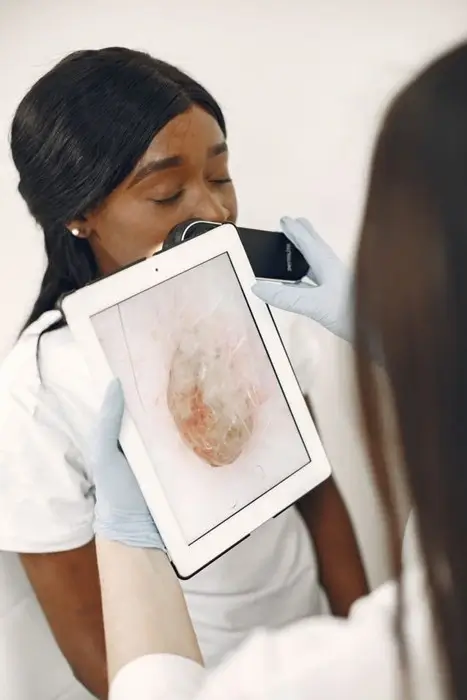
Some skin damage from sun exposure goes beyond appearance.
Actinic keratoses are dry, scaly patches on the face, scalp, ears, lips or hands that often feel like sandpaper. They are the most common precancer on sun-damaged skin, and about 5% to 10% turn into skin cancer.
Book an exam for any spot that matches the ABCDE melanoma signs: asymmetry, irregular borders, uneven color, a diameter larger than a pencil eraser or changes over time.
Sores that won't heal, pearly bumps and spots that bleed on their own deserve the same attention. People with darker skin should also check nails, palms and soles, common melanoma sites in deeper skin tones.
Existing damage can soften, though deep changes rarely disappear completely. Daily sunscreen gives skin room to repair itself and helps every other option work.
Vitamin C and niacinamide gently target dullness and dark spots. Add one active at a time, because irritation can leave new dark marks.
In-office procedures reach further. Chemical peels and intense pulsed light can fade sunspots and redness, though IPL carries burn and pigment risks on tanned or darker skin.
For deep wrinkles and rough texture, ablative laser skin resurfacing removes outer layers so fresh skin can grow. New skin usually covers the area in 7 to 10 days, with full recovery taking at least a month. Heavy sun in the two months before treatment can cause lasting color changes, so plan it between trips.
Conclusion
Source: Pexels.
Sun damage for skin rarely announces itself. It accumulates through years of window seats, high-altitude detours and ordinary afternoons outdoors, showing up long after the cause is forgotten.
That damage can't be fully erased, but it can be stopped from stacking up. Daily sunscreen, UPF clothing and a lowered window shade do more than most travelers expect.
Existing changes can soften with retinoids, peels and laser resurfacing, though deep damage rarely disappears completely. Every option works better when skin is protected from further exposure.
New or changing spots deserve a dermatologist's eye before any cosmetic booking. Catching problems early remains the surest way to protect both your health and your appearance.
So check the UV Index before you head out, pack the sunscreen stick and book that skin exam you've been putting off. Your future trips — and your future skin — will thank you for starting now.
Disclaimer:
This post may contain affiliate links. I receive a small commission at no cost to you when you make a purchase using my link.