Every August, Dubai's workshops fill up with the same conversation. An owner walks in with a car wrapped six or nine months earlier, pointing at a bumper edge where the film has curled back, a roof gone dull and blotchy, or a bonnet with a bubble the size of a hand.
At handover, that same car looked flawless. The wrap was a bargain — which is exactly the problem.
The removal, the adhesive residue, and sometimes the clear coat damage underneath are not. Finding the best car wrapping in Dubai has to offer isn't about chasing the lowest quote — it's about knowing which five or six things separate a wrap that survives four summers from one that fails before its first.
The good news is that the shops doing it right leave clues, if you know where to look. Here are the questions that separate a wrap that lasts from one that's already failing underneath.
Best Automotive Wrapping in Dubai: 7 Things to Check First
Source: Unsplash
1. Ask what gets taken off the car
This is the single most reliable question you can ask, and the answer tells you almost everything.
A proper installation means removing door handles, mirror caps, badges, lights, trim, and often bumpers, so the film wraps around each panel edge and tucks underneath.
A cheap installation cuts the film around those parts and lays the edge on the surface, sometimes sealed with a knifeless tape line that sits proud of the paint.
That exposed edge is where every failure starts. Heat expands it, wash pressure catches it, sand works underneath it, and by the second summer it's lifting.
Panel gaps and handle surrounds are also where you'll see it first on someone else's car — glance at any wrapped vehicle in a car park and look at the door handle recesses. You'll immediately be able to sort the good work from the bad.
If a shop says disassembly isn't necessary, you have your answer.
2. Cast film or calendared film
Source: Pexels.
Vinyl comes in two fundamentally different constructions, and the price gap between them explains most of the price gap between quotes.
Cast film is manufactured in a way that leaves it essentially stress-free. It conforms to complex curves without fighting back, stays dimensionally stable in heat, and releases cleanly at removal. It's what the premium wrap brands sell for full vehicle work.
Calendared film is rolled and stretched during production, and it wants to shrink back to that shape. In a temperate climate it takes a couple of years to misbehave.
In Dubai, where bodywork bakes daily, it starts pulling back from edges and recesses within months. It's intended for flat signage, not for a car bonnet.
Ask which film, ask which series, and ask for the manufacturer's data sheet. A shop working with premium cast film will tell you the exact product without hesitation.
3. Find out how long the car stays in the bay
Source: Pexels.
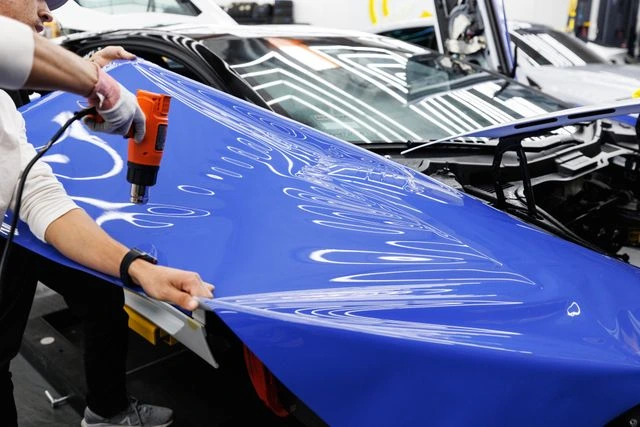
A full wrap done properly is a multi-day job — disassembly, thorough decontamination and paint prep, application, post-heating of every edge and recess, reassembly, and curing time before the car goes out.
A same-day full wrap is a red flag on its own. It means the corners were cut somewhere, and the corners in question are exactly the ones that determine whether the wrap lasts.
Post-heating deserves special mention. Film stretched into a recess has memory and will try to return to shape; heating it to the manufacturer's specified temperature resets that memory permanently.
Skip that step and the wrap looks perfect at handover and starts releasing from the recesses within a season. You can't see whether it was done. You can only ask, and judge the confidence of the answer.
4. Check the paint before the film goes on
Source: Pexels.
Film needs sound paint to bond to. If the clear coat is failing, if there are chips down to primer, or if a panel has been resprayed poorly at some point, the wrap will lift in those areas regardless of how well it's installed.
A good workshop inspects and tells you — sometimes that a panel needs correction first, sometimes that a wrap is the wrong product for the car's current condition. A shop that quotes without looking closely at the paint isn't planning to take responsibility for the outcome.
The same applies to decontamination. Wax, sealant, tar and embedded fallout all compromise adhesion. Proper prep involves a chemical decontamination and often a light machine polish, not a rinse and a wipe-down.
5. Ask to see a three-year-old wrap
Anyone can photograph a car on handover day. The meaningful portfolio is the one that shows work three or four years into Dubai's climate.
Ask directly whether the shop can show you a wrap it did years ago, or put you in touch with the owner. A workshop with a long client base and repeat customers will have plenty. One that only has fresh installations to show you is telling you something about either its age or its retention.
Removal work is the same test in reverse. Shops that regularly remove their own wraps and show original paint intact underneath have earned the confidence.
Approval must be obtained before the film is applied, and the vehicle registration is updated to reflect the new color afterwards. The permit process runs through the Dubai Police app, with an inspection at the end.
Skipping it risks fines, a failed inspection, and problems on an insurance claim — and it usually surfaces at the worst moment, at renewal or after an accident.
Note also that private vehicles can carry a color change but not commercial branding, logos, or text, and color schemes resembling emergency services won't be approved.
Established workshops handle or guide this as part of the job. If a shop shrugs it off as unnecessary, that single sentence tells you how it approaches everything else.
Requirements do get updated, so confirm the current process with the RTA or Dubai Police before you commit to a color.
7. Read the warranty properly
“Warranty included” means nothing on its own. The questions that matter:
Does it cover the material, the installation labor, or both? Edge lifting is a labor issue; discoloration is a material issue. You want both covered.
How long, and what specifically voids it?
Is it backed by a manufacturer, or only by the shop's own promise?
For reference at the premium end of the Dubai market, Desert Diamond in Al Quoz quotes warranty coverage of up to 12 years on work and materials, with full vinyl wraps starting from 6,500 AED and premium tiers running to around 13,600 AED, plus colour-change PPF above that.
That's a useful benchmark for what serious coverage and serious pricing look like — and a way to read what a substantially cheaper quote is really telling you.
Source: Pexels.
What the cheap quote is actually buying you
When a full wrap comes in dramatically under the market, the savings come from a predictable list: calendered film instead of cast, no disassembly, minimal paint prep, no post-heating, a compressed timeline, and no paperwork handling.
The result is a car that looks correct for a few months, then starts failing at the edges through its first proper summer.
And removal of a failed cheap wrap is its own expense — degraded adhesive that's been heat-cycled for a year fights the removal and can pull clear coat with it, at which point the “saving” has turned into a paint repair bill.
Aftercare: your half of the deal
Even excellent work needs reasonable treatment.
Let it cure for several days before the first wash.
Hand wash only, with pH-neutral products. Automatic brush washes are the fastest way to ruin a wrap.
Keep pressure washers away from edges and seams, and never at close range.
Remove bird droppings and fuel spills immediately — heat sets them into film quickly.
Park covered wherever realistically possible. Shade will do more for wrap life than any upgrade in film specification.
Consider a ceramic coating over the wrap for easier cleaning and added UV resistance, particularly on satin and matte finishes.
Conclusion
Source: Unsplash
The best wrap shops in Dubai all behave the same way: they strip the car down, they name their film, they take several days, they inspect the paint before quoting, they handle the approval, and they can show you work that's already survived a few summers.
That combination costs more than the alternative. It also costs less than doing the job twice — which is the actual choice most owners are making without realising it.
Disclaimer:
This post may contain affiliate links. I receive a small commission at no cost to you when you make a purchase using my link.